

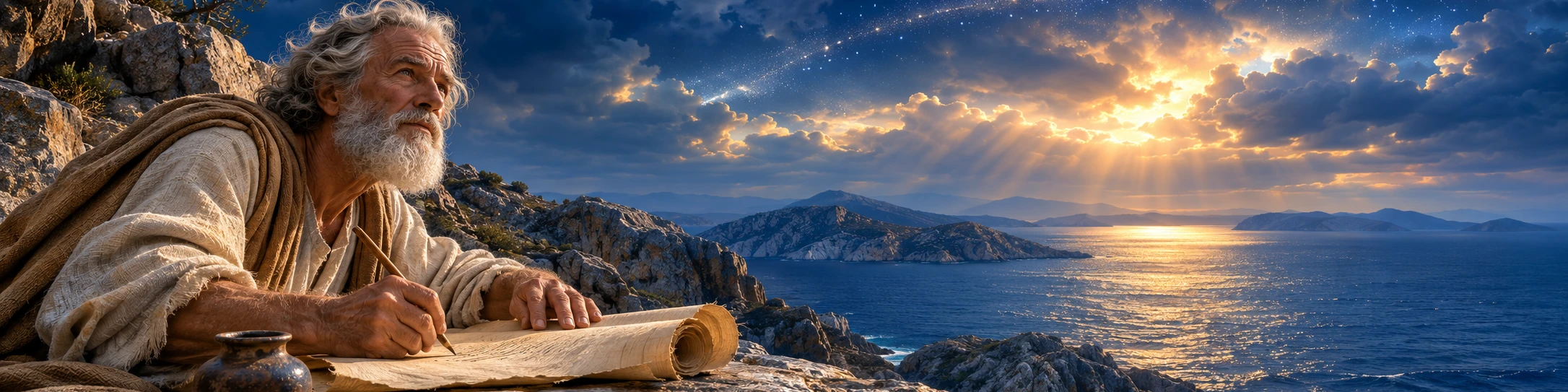
Just imagine for a moment how many people would like to know the future! Now imagine an elderly man exiled to a barren island because a despotic emperor denied Christians religious freedom. Imagine, too, that he had ended up there because, to silence him, they had thrown him into a cauldron of boiling oil, and God had miraculously brought him out alive!
It was between A.D. 81 and 96, and Domitian, son of Vespasian and brother of Titus, ruled Rome. The emperor was troubled by the Christians and by the apostle John, of whom we are speaking, because his influence was vital to the spread of Christianity. He had witnessed the miracles, deeds and words of the Master of masters, Jesus Christ. He was present at Jesus' trial before the Jewish Sanhedrin. He stood at the foot of the cross as Jesus was dying. He ran with the apostle Peter to the empty tomb and was the first to see the linen cloths lying in order because Christ had risen. Thus he wrote: “That which was from the beginning, which we have heard, which we have seen with our eyes, which we have looked upon, and our hands have handled...”.
Now, in the twilight of his life, the world seemed to forget him. His voice appeared silenced, and no one could be influenced by the elderly apostle's words. Yet in the solitude of Patmos he brings us Revelation, his last great work, the book that is the subject of our study.
“Apocalypse” comes from the Greek word Apokalupsis, meaning “to reveal” or “to remove the veil.” In His mercy the Lord Jesus removed the veil that covered humanity's eyes to show how the future would unfold. That is Revelation: history written in advance. We invite you, therefore, to enjoy this fascinating book, Revelation (hereafter abbreviated Rev.).
1 John 1:1 — That which was from the beginning, which we have heard, which we have seen with our eyes, which we have looked upon, and our hands have handled, of the Word of life;
Those who study it gain a broad understanding:
- Of the history of our era.
- Of the significance of current events.
- Of the future through its extraordinary prophecies.
- Of the cosmic struggle between good and evil.
It outlines the rise and work of the antichrist, identified by 666.
Revelation encompasses virtually all biblical truths.
It explains the prophecies of Daniel, written in the sixth century B.C.
It fills us with comfort and hope by presenting a vision of a better world.
It tells us about the author of life and presents Jesus Christ in many ways.
It clarifies that the word “Apocalypse” actually means “Revelation.”
.
Rev. 1:1 — The Revelation of Jesus Christ, which God gave unto him, to shew unto his servants things which must shortly come to pass; and he sent and signified it by his angel unto his servant John:
I. The historical setting of its origin
The book of Revelation was written by the apostle John on the island of Patmos.
Christians refused to worship the emperor as God or to worship pagan deities, which led to persecution and serious difficulties in the early church. To silence the apostle John, he was banished to the barren, rocky island of Patmos in the Aegean Sea. There he received the most important prophetic revelations of the New Testament. The author affectionately introduces himself as “your brother”: John the apostle, brother of James, son of Zebedee.
Rev. 1:9 — I John, who also am your brother, and companion in tribulation, and in the kingdom and patience of Jesus Christ, was in the isle that is called Patmos, for the word of God, and for the testimony of Jesus Christ.
The book was written around A.D. 96, at the end of the reign of Emperor Domitian, who ruled from 81 to 96.
Victorinus of Pettau or Poetovio, in present-day Slovenia, wrote near the end of the third century A.D. that when John said these things, he was on the island of Patmos, condemned to work in the mines by Caesar Domitian (Commentary on Revelation, chapter 10).
Between 600 B.C. and A.D. 100, “apocalyptic” was a genre of Hebrew literature. The first such text was the book of Daniel, written in the sixth century B.C.
II. How to understand Revelation
1. The book defines itself as “prophecy,” and the revelation was given through a series of visions. The prophet was transported in spirit to a particular scene, and an angel explained it to him. Seventy-three times he says, “I saw,” “I looked,” or “I heard.” What command did the Lord give John in this context?
Rev. 1:3 — Blessed is he that readeth, and they that hear the words of this prophecy, and keep those things which are written therein: for the time is at hand.
Rev. 22:7 — Behold, I come quickly: blessed is he that keepeth the sayings of the prophecy of this book.
Rev. 22:10 — And he saith unto me, Seal not the sayings of the prophecy of this book: for the time is at hand.
Rev. 22:18-19 — For I testify unto every man that heareth the words of the prophecy of this book, If any man shall add unto these things, God shall add unto him the plagues that are written in this book: And if any man shall take away from the words of the book of this prophecy, God shall take away his part out of the book of life, and out of the holy city, and from the things which are written in this book.
Rev. 1:11 — Saying, I am Alpha and Omega, the first and the last: and, What thou seest, write in a book, and send it unto the seven churches which are in Asia; unto Ephesus, and unto Smyrna, and unto Pergamos, and unto Thyatira, and unto Sardis, and unto Philadelphia, and unto Laodicea.
2. It uses language rich in allegories and symbols:
To decipher it, let the Bible itself reveal the meaning of the symbols.
THE SEVEN KEYS TO PROPHECY
a) What do winds and waters indicate in symbolic prophecies?
Winds represent wars.
Waters denote multitudes, nations and tongues, Rev. 17:15.
Jeremiah 49:36-37 — And upon Elam will I bring the four winds from the four quarters of heaven, and will scatter them toward all those winds; and there shall be no nation whither the outcasts of Elam shall not come. For I will cause Elam to be dismayed before their enemies, and before them that seek their life: and I will bring evil upon them, even my fierce anger, saith the Lord; and I will send the sword after them, till I have consumed them:
Rev. 7:1 — And after these things I saw four angels standing on the four corners of the earth, holding the four winds of the earth, that the wind should not blow on the earth, nor on the sea, nor on any tree.
Waters denote multitudes, nations and tongues.
Rev. 17:15 — And he saith unto me, The waters which thou sawest, where the whore sitteth, are peoples, and multitudes, and nations, and tongues.
b) What do beasts, heads, horns and wings represent?
Beasts represent kingdoms.
Daniel 7:23 — Thus he said, The fourth beast shall be the fourth kingdom upon earth, which shall be diverse from all kingdoms, and shall devour the whole earth, and shall tread it down, and break it in pieces.
Daniel 7:17 — These great beasts, which are four, are four kings, which shall arise out of the earth.
Many nations are still represented by similar symbols today: the United States by an eagle; Great Britain by a lion; Russia by a bear; China by a dragon; and France by a rooster.
Heads and horns indicate kings or kingdoms.
Daniel 7:24 — And the ten horns out of this kingdom are ten kings that shall arise: and another shall rise after them; and he shall be diverse from the first, and he shall subdue three kings.
Daniel 8:21 — And the rough goat is the king of Grecia: and the great horn that is between his eyes is the first king.
Rev. 17:12 — And the ten horns which thou sawest are ten kings, which have received no kingdom as yet; but receive power as kings one hour with the beast.
Wings symbolize speed.
Habakkuk 1:8 — Their horses also are swifter than the leopards, and are more fierce than the evening wolves: and their horsemen shall spread themselves, and their horsemen shall come from far; they shall fly as the eagle that hasteth to eat.
In prophecies, each prophetic day corresponds to one year.
Ezekiel 4:6 — And when thou hast accomplished them, lie again on thy right side, and thou shalt bear the iniquity of the house of Judah forty days: I have appointed thee each day for a year.
Numbers 14:34 — After the number of the days in which ye searched the land, even forty days, each day for a year, shall ye bear your iniquities, even forty years, and ye shall know my breach of promise.
c) The number most frequently used is seven, which represents completeness.
3. Its four main divisions or prophetic lines are:
1. Seven churches
2. Seven seals
3. Seven trumpets
4. The final events of the great conflict described in chapters 12 to 22.
4. Many things that remained sealed in the book of Daniel were revealed in Revelation.
5. This book contains a total of 505 allusions to passages in other books of the Bible; 325 refer to the Old Testament.
To understand Revelation, we must turn to passages throughout the Bible. We can focus on its deepest truths, which will help us live filled with glorious hope and have the heavenly assurance of understanding our Creator's purposes to find the way of life and salvation.
6. Through which channels did the message of Revelation pass to reach us?
Rev. 1:1 — The Revelation of Jesus Christ, which God gave unto him, to shew unto his servants things which must shortly come to pass; and he sent and signified it by his angel unto his servant John:
Rev. 1:4 — John to the seven churches which are in Asia: Grace be unto you, and peace, from him which is, and which was, and which is to come; and from the seven Spirits which are before his throne;
Rev. 1:19 — Write the things which thou hast seen, and the things which are, and the things which shall be hereafter;
7. Why did God use parables and symbols to communicate His message to us?
Luke 8:10 — And he said, Unto you it is given to know the mysteries of the kingdom of God: but to others in parables; that seeing they might not see, and hearing they might not understand.
8. What does the Lord forbid concerning the prophetic Word?
Rev. 22:18-19 — For I testify unto every man that heareth the words of the prophecy of this book, If any man shall add unto these things, God shall add unto him the plagues that are written in this book: And if any man shall take away from the words of the book of this prophecy, God shall take away his part out of the book of life, and out of the holy city, and from the things which are written in this book.
9. Who is the true author of the entire Bible?
2 Timothy 3:16 — All scripture is given by inspiration of God, and is profitable for doctrine, for reproof, for correction, for instruction in righteousness:
2 Peter 1:21 — For the prophecy came not in old time by the will of man: but holy men of God spake as they were moved by the Holy Ghost.
10. To what is the prophetic word compared?
2 Peter 1:19 — We have also a more sure word of prophecy; whereunto ye do well that ye take heed, as unto a light that shineth in a dark place, until the day dawn, and the day star arise in your hearts:
11. What promises does God give those who read, hear and keep the things written in this book?
Rev. 1:3 — Blessed is he that readeth, and they that hear the words of this prophecy, and keep those things which are written therein: for the time is at hand.
Rev. 3:10 — Because thou hast kept the word of my patience, I also will keep thee from the hour of temptation, which shall come upon all the world, to try them that dwell upon the earth.
a) What does He call the one who reads, hears and keeps them?
b) From what does He promise to keep that person?
My decision: I ask God to enlighten me to understand this inspired book, and I desire to respect His counsel by applying it in my life.
To pass, you need at least 70% correct answers.